
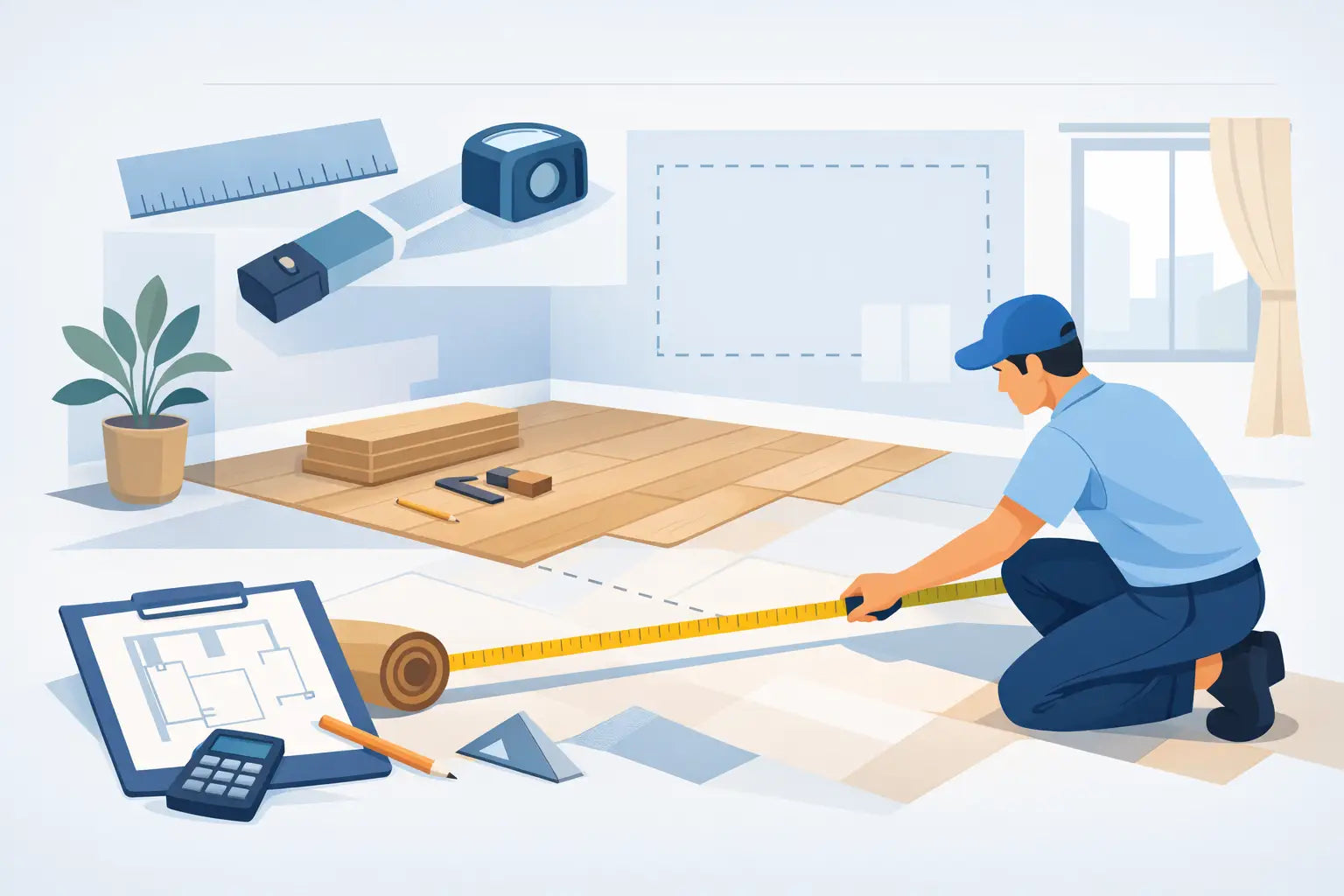
A flooring deal stops looking like a deal fast when you order too little and stall the job - or too much and pay for boxes you did not need. If you are wondering how to measure flooring rooms accurately, the good news is that the process is simple once you break it into a few clean steps.
Getting the numbers right matters whether you are updating one bedroom, replacing worn rental flooring, or pricing out a full-house renovation. Premium hardwood, laminate, and vinyl at liquidation pricing can save you real money, but only if your measurements are solid from the start.
What you need before you measure flooring rooms
You do not need pro-grade equipment. A tape measure, notepad, pencil, calculator, and a basic sketch of the room are enough for most spaces. If you prefer, a phone calculator works fine, but write every number down as you go. Memory is where measuring mistakes usually start.
Measure in feet and inches, then convert to decimal feet only when you calculate square footage. That keeps your raw numbers easier to check later. It also helps if you are comparing multiple rooms and trying to avoid small math errors that turn into extra cartons.
How to measure flooring rooms step by step
Start by sketching the room from a top-down view. It does not need to be pretty. You just want a shape you can label with wall lengths, closets, door cut-ins, and any areas that change depth.
Next, measure the longest wall and the opposite wall. Then measure the width in at least two places. This matters because many rooms are not perfectly square, especially in older homes, flips, and additions. If the numbers vary slightly, use the larger measurement. That gives you safer coverage when ordering.
For a simple rectangular room, multiply length by width. A room that is 12 feet by 15 feet equals 180 square feet. That is your base floor area before waste.
For inches, convert them to decimals before multiplying. Six inches is 0.5 feet, three inches is 0.25 feet, and nine inches is 0.75 feet. So if a room measures 12 feet 6 inches by 15 feet, the math is 12.5 x 15 = 187.5 square feet.
That basic approach works for many bedrooms, offices, and open living spaces. The challenge comes when the room is not a clean rectangle.
How to measure irregular flooring rooms
Most real rooms have a bump-out, closet, angled wall, hallway connection, or small nook that changes the layout. Do not try to force an odd shape into one formula. Break the room into smaller rectangles instead.
Let’s say your room has a main area that measures 14 x 16 and a closet that measures 3 x 5. The main space is 224 square feet, and the closet adds 15 square feet. Your total is 239 square feet.
If the room has an L-shape, divide it into two rectangles and calculate each one separately. If there is a bay area or offset section, treat that as its own piece. This method is faster, easier to verify, and much more reliable than guessing.
Angled walls can complicate things, but in many residential flooring jobs, measuring the widest and longest points and then dividing the shape into manageable sections gets you close enough to order correctly. If the angle is significant or the room is highly custom, it is worth double-checking every segment before you buy.
Should you subtract closets, cabinets, or islands?
Usually, closets get included because they need flooring too, unless you are intentionally using a different material there. Built-in cabinets and fixed kitchen islands are different.
If flooring will not run underneath a permanent cabinet line or a heavy built-in, you can subtract that area. But be careful. Some installations do continue under certain appliances or around partial cabinet layouts, and product type matters. Floating laminate and vinyl floors often have different installation requirements than glue-down products or nail-down hardwood.
If you are not fully sure whether flooring will stop at the cabinet edge or run beneath part of the layout, do not make a hard subtraction too early. It is better to confirm your installation plan first than underorder by trying to trim every square foot.
Waste factor matters more than people think
Once you know the room’s square footage, do not order that exact number. You need extra material for cuts, pattern alignment, damaged pieces, and future repairs. That extra is your waste factor, and it is not optional.
For straightforward rooms with a basic layout, many buyers add 5 percent to 10 percent. For diagonal installs, multiple angles, narrow planks in tight spaces, or whole-home projects with lots of transitions, 10 percent to 15 percent is often safer.
Here is the practical way to think about it. If your room measures 200 square feet and you add 10 percent waste, you should order 220 square feet. That buffer protects the project and keeps you from scrambling to match a lot later.
This is especially important when you are buying premium first-quality flooring at unbeatable liquidation prices. Inventory can move fast, and waiting to reorder a missing carton is not always the best gamble.
Measuring multiple rooms for one flooring order
If you are installing the same flooring across several rooms, measure each room separately first. Do not try to estimate the entire floor plan at once. Room-by-room numbers are easier to check and help you spot where waste may run higher.
After you total the square footage for all rooms, then add your waste percentage to the combined amount. In some connected layouts, shared cuts can reduce waste slightly. In chopped-up spaces with closets, turns, and doorways, waste usually goes the other way.
This is where practical judgment matters. A wide-open living, kitchen, and hallway layout may need a different waste allowance than a house with small bedrooms, tight baths, and lots of door transitions.
Common measuring mistakes that cost money
The biggest mistake is assuming the room is square because it looks square. Small wall variations can add up, and using the shorter measurement can leave you short.
Another common problem is forgetting closets, pantries, or small connecting areas. These spaces do not seem like much on their own, but together they can add a full carton or more.
The third issue is skipping waste or using too little. Buyers often focus on the lowest possible square footage because they want to keep the order tight. That sounds smart until one bad cut, one damaged plank, or one discontinued lot creates a bigger expense later.
There is also the carton issue. Flooring is sold by the box, and each box covers a set amount of square footage. You will need to round up to full cartons, not order the exact decimal total. Always check coverage per carton before finalizing quantities.
Measuring for hardwood, vinyl, and laminate
The room-measuring process is largely the same across flooring categories, but your installation style can change the amount of waste you should plan for.
Hardwood often needs a little more caution because natural variation, layout direction, and cut planning can affect usable yield. Laminate is typically more predictable, but room shape still drives waste. Vinyl plank is often forgiving in standard layouts, though awkward spaces and pattern planning can still increase overage needs.
The real point is this - the room measurement gives you the foundation, but the flooring type and install pattern influence the final order quantity. If you are choosing between products, measure first so you can compare real material needs, not rough guesses.
When to get a second opinion
If your project includes stairs, curved walls, multiple angles, or a large continuous layout, getting expert support is worth it. The same goes for investment properties and contractor jobs where time matters and delays cost money.
A confident measurement saves money. A questionable one can eat up the savings you thought you were getting. That is why smart buyers do the basic math themselves, then verify before placing a major order.
For homeowners comparing options online, tools like a room visualizer help with style decisions, but accurate room dimensions are still what turn a good-looking floor into a smooth purchase. If you are buying premium flooring because you want first-quality results without showroom markups, precision is part of the value.
Measure slowly, write everything down, round up where needed, and give yourself enough material to finish the job once and finish it right.