
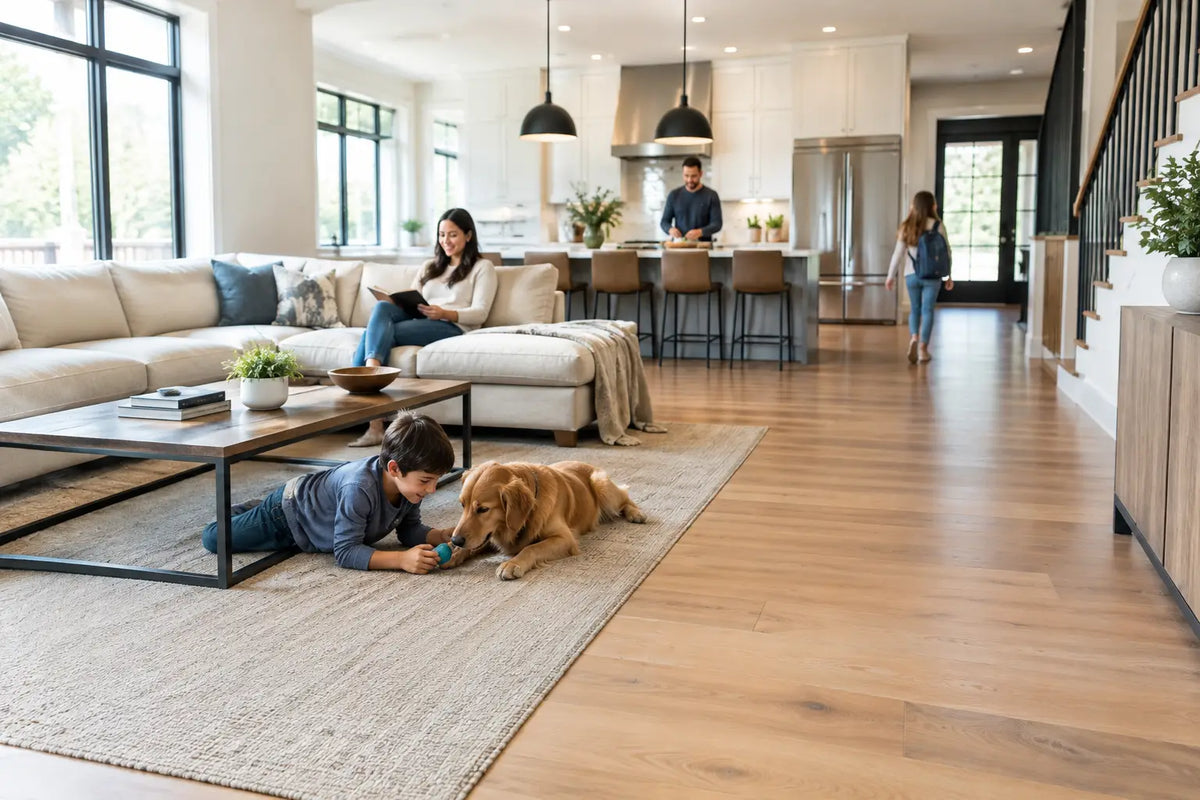
A large home puts flooring through a different kind of test. More square footage means longer sightlines, more transitions, more foot traffic, and a bigger investment if the product is not right for the way your household lives. The best flooring for large homes needs to create a cohesive look while standing up to daily activity, pets, children, entertaining, and the practical realities of maintaining a whole home.
The smartest choice is rarely one material used everywhere without thought. It is a coordinated flooring plan that balances appearance, performance, installation requirements, and budget. For many whole-home projects, first-quality hardwood, luxury vinyl, waterproof flooring, and laminate can each play an important role.
What Makes Flooring Work in a Large Home?
In a smaller room, a flooring decision is mostly visual. In a large home, it affects the way the entire property feels and functions. A floor that looks excellent in one room can become visually busy over several thousand square feet. Likewise, a product that is easy to maintain in a single bedroom may feel demanding when it covers every main living area.
Start with the rooms that establish the home's visual direction: the entry, living room, kitchen, hallways, and open-concept spaces. These areas often connect directly, so a consistent color, plank width, and surface style can make the home feel more intentional. Long hallways and open layouts especially benefit from flooring that carries naturally from one space to the next.
Durability matters just as much. Large homes often have multiple entrances, active family areas, guests, and distinct zones with different moisture exposure. Consider how each area is used before choosing one product for the entire property. A beautiful floor should fit your real routine, not ask you to reorganize your routine around it.
Best Flooring for Large Homes: Top Material Choices
Hardwood for lasting character and strong resale appeal
Hardwood remains a leading option for main living areas, dining rooms, bedrooms, and formal spaces. Its natural grain brings warmth and visual depth to expansive rooms, and wider planks can look especially at home in larger layouts. The right hardwood color can also connect traditional architecture, contemporary furnishings, and changing design preferences over time.
Hardwood is a strong fit when you want a premium, enduring look and are prepared to choose carefully around moisture-prone spaces. It is not the automatic answer for every kitchen, laundry room, or bath. Household activity, pet traffic, and the wood construction all matter. Engineered hardwood can be a practical consideration for homeowners who want genuine wood appearance with added dimensional stability in appropriate indoor applications.
For a large-home remodel, look beyond the box price. Compare the overall visual quality, construction, available quantity, and how the floor will connect across rooms. Factory-closeout hardwood can be an excellent opportunity to buy first-quality flooring with substantial style and value, particularly when the available inventory supports your project's square footage plus an appropriate overage.
Luxury vinyl for active, versatile spaces
Luxury vinyl is one of the most practical choices for large homes with busy kitchens, family rooms, mudrooms, and pet-friendly living areas. It offers realistic wood and stone visuals with a more forgiving maintenance routine than many natural materials. Waterproof options can be particularly useful where spills, wet shoes, and everyday messes are part of the picture.
For homeowners trying to create a unified whole-home look, luxury vinyl can deliver wide-plank visuals and consistent color across high-use spaces. It is also a compelling option for rental properties, flips, and investment homes where durability, attractive design, and project value need to work together.
Not every luxury vinyl product has the same construction or wear performance. Review the product specifications, installation method, texture, thickness, and intended use. Choosing the right level of performance for the room helps prevent paying for features you do not need or selecting a floor that is underbuilt for the traffic it will receive.
Waterproof flooring for kitchens, entries, and practical zones
Waterproof flooring gives large households more freedom in the rooms that see the most daily use. Entrances, kitchens, breakfast areas, laundry rooms, and family gathering spaces all benefit from flooring designed with moisture resistance in mind. A waterproof surface can simplify cleanup without forcing you to sacrifice the wood-look style many homeowners want.
This category is especially useful when a home's open layout makes material transitions difficult. Rather than breaking up the kitchen and adjoining living area with sharply different floors, you may be able to use a coordinated waterproof product across both spaces. The result can feel cleaner and more continuous.
Waterproof does not mean every installation condition is identical. Subfloor condition, room measurements, expansion requirements, and manufacturer instructions still matter. Plan the layout before ordering, especially when covering large uninterrupted areas.
Laminate for whole-home value and visual consistency
Laminate can be a smart fit for bedrooms, living areas, hallways, and other dry spaces where you want the look of wood at a budget-conscious project cost. Modern laminate options offer convincing visuals, useful durability, and a broad range of colors that work well in everything from updated traditional homes to clean contemporary interiors.
For large homes, laminate's value is often in its ability to cover substantial square footage attractively while keeping more of the budget available for other renovation priorities. It can be especially appealing for property owners preparing a rental, resale, or multi-room refresh.
As with any category, the details matter. Confirm whether the product is intended for your specific room, how it handles moisture exposure, and which underlayment or installation materials are required. A good-looking floor is only a good value when it matches the application.
Plan One Look, Not One Rule for Every Room
The most successful large-home flooring projects use repetition strategically. That may mean the same flooring through the main living spaces, a coordinated waterproof option in wet zones, and a compatible product or color family in bedrooms. The goal is not to make every room identical. The goal is to avoid a disconnected, patchwork result.
Choose your color direction early. Light and natural tones can help broad spaces feel open and relaxed, while medium wood tones often hide everyday dust and traffic better than very dark or very light finishes. If the home has a lot of natural light, take time to view flooring in different conditions. Color can shift noticeably between a bright entry, a shaded hallway, and an evening-lit living room.
Plank dimensions deserve attention, too. Wider planks often create a calmer look in big, open rooms because there are fewer visible seams. In a large layout, they can make the flooring feel appropriately scaled to the architecture. However, the best choice still depends on the product's construction, the room dimensions, and your preferred style.
Budget for Quantity, Waste, and Future Needs
A large-home flooring purchase rewards careful measurement. Calculate each room separately, account for closets and hallways, and add a reasonable waste factor based on the layout and installation pattern. Complex angles, diagonal placement, stairs, and multiple transitions can require more material than a simple rectangular room.
It is also wise to think about future repairs before a closeout product sells through. Factory-closeout, discontinued, overstock, and special-buy flooring can provide exceptional value because of how it is sourced, while still being first-quality product. The trade-off is that a particular color or collection may not be replenished once available inventory is gone.
When the product is right for your project, consider purchasing enough material to complete the job and retain a small amount for future repairs. This is not artificial urgency. It is practical planning for changing inventory and for the long-term consistency of a large flooring installation.
Get More Confidence Before You Order
Large homes make small selection mistakes more expensive, so use the tools available to narrow the field. Compare visuals in the rooms you are updating, review product details, and order samples when you need to see color and texture under your own lighting. Sample shipping applies, but it can be a worthwhile step before committing to a whole-home purchase.
If you are renovating in Dallas-Fort Worth, visiting a showroom can help you compare materials side by side and discuss the practical differences between hardwood, luxury vinyl, waterproof flooring, and laminate. For projects elsewhere in the United States, online ordering and nationwide delivery make it possible to access first-quality closeout opportunities while still getting knowledgeable product guidance.
A large home deserves a flooring plan that looks connected, performs where it matters, and respects the size of the investment. Focus on the rooms that set the tone, choose materials around real-life use, and take advantage of first-quality factory-closeout inventory when it aligns with your quantity and design needs. The right floor will not just fill more square footage - it will make the entire home feel more considered every day.