
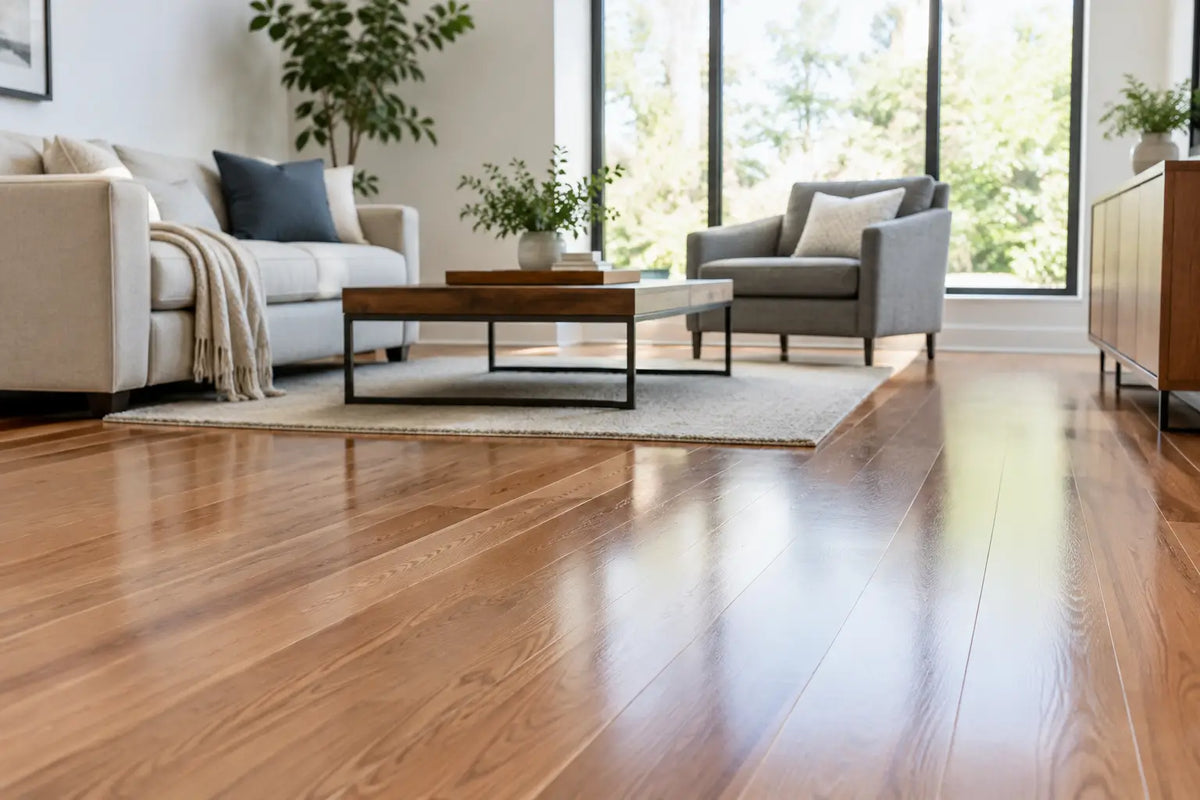
A smooth hardwood floor changes the way a room reads. Light travels cleanly across the boards, grain patterns look more defined, and the finished floor can feel tailored rather than rustic. Smooth finish hardwood flooring is a strong choice for homeowners who want a refined, classic surface with natural wood character - but it is not automatically the best fit for every household, room, or renovation budget.
The right decision comes down to how you use the space, how much visible texture you want, and whether you prefer a floor that shows its story over time or one that disguises day-to-day activity. Understanding the trade-offs before you buy helps you choose a first-quality hardwood floor that looks right on installation day and still suits your home years later.
What Is Smooth Finish Hardwood Flooring?
Smooth finish hardwood flooring has a level, even surface with little to no intentional distressing, wire brushing, hand scraping, or saw marks. It may be solid hardwood or engineered hardwood, and it can come in a range of species, plank widths, colors, and finish systems. The defining feature is the surface texture: it feels polished and consistent underfoot while allowing the wood grain to remain visible.
That clean surface creates a more formal visual effect than heavily textured wood. It works especially well in traditional homes, transitional interiors, contemporary spaces, and renovations where cabinetry, trim, or furniture already provide plenty of texture. A smooth floor also gives natural variation in the wood more room to stand out. Oak grain, maple’s quieter appearance, and hickory’s bolder movement each look different when the surface is not intentionally weathered.
Smooth does not mean artificial or flat. First-quality hardwood retains the color shifts, knots, mineral streaks, and grain variation that make real wood appealing. The floor simply has a cleaner finish profile.
Why Homeowners Choose a Smooth Hardwood Surface
The biggest advantage is appearance. Smooth boards create crisp lines and a continuous look across an open floor plan. They pair easily with painted cabinets, stone counters, modern fixtures, and traditional millwork because the floor is visually versatile rather than tied to a heavily rustic trend.
Cleaning is another practical benefit. With fewer grooves and low spots, a smooth surface is generally easier to sweep or vacuum. Dust, pet hair, and everyday debris have less texture to settle into. For busy homeowners, that can make routine floor care feel more straightforward.
Smooth hardwood can also be a smart long-term design choice. A floor with a natural color and uncomplicated surface texture can move through several paint colors and furniture updates without looking dated. That matters for homeowners planning a whole-home renovation, as well as rental-property owners and investors who want an attractive, broadly appealing finish.
The value opportunity is worth considering, too. Factory-closeout, overstock, discontinued, end-of-run, and special-buy inventory can provide access to first-quality hardwood at exceptional value. The reason for the opportunity is often inventory sourcing, not a compromise in product quality. If a smooth hardwood style fits your project, a closeout collection may allow you to consider a wider plank, a premium finish, or a higher-grade visual while staying closer to budget.
The Trade-Off: Smooth Floors Show More
A smooth floor reflects light more evenly, which can make surface activity easier to notice. Small scratches, pet claws, grit near exterior doors, and scuffs from moving furniture may be more visible than they would be on a wire-brushed or hand-scraped floor. Dark colors and glossy finishes tend to emphasize this effect further.
That does not mean smooth hardwood is fragile. The product’s species, construction, finish, wear layer in engineered flooring, and maintenance routine all matter. Still, homeowners with large dogs, very active children, or frequent indoor-outdoor traffic should choose color and sheen carefully. A medium-tone floor with a low-luster finish usually hides everyday activity better than a near-black or high-gloss option.
For a quieter visual result, look for natural color variation and grain movement rather than a perfectly uniform stain. Oak is often a practical choice because its grain helps soften the appearance of small marks. Wider planks can look impressive, but they also make each board more visually prominent, so consider the scale of the room and your tolerance for natural variation.
Smooth Finish Hardwood Flooring by Room
Living rooms, dining rooms, bedrooms, offices, and hallways are natural places for smooth hardwood. These rooms benefit from its clean appearance and comfortable, finished feel. In an open-plan home, it can establish a consistent foundation that makes adjoining spaces feel connected.
Kitchens require a more personal calculation. Hardwood can look beautiful in a kitchen, especially when the goal is a warm, continuous main-level design. However, kitchens see dropped utensils, water splashes, food spills, and chair movement. Use protective pads under furniture, clean spills promptly, and avoid treating wood as if it were waterproof flooring.
For bathrooms, laundry rooms, and other areas with frequent or prolonged moisture exposure, hardwood is generally not the practical choice. A water-resistant hard-surface alternative may better match the conditions while still providing a wood-inspired look. For basements and below-grade spaces, engineered hardwood may be appropriate in some cases, but the project should follow the manufacturer’s installation requirements and site conditions.
Solid or Engineered: Construction Matters
Smooth finish hardwood flooring is available in solid and engineered construction. Neither is automatically better. The best option depends on the room, subfloor, installation method, and project goals.
Solid hardwood is milled from a single piece of wood. It offers an authentic traditional format and may be refinished over its service life depending on the product and condition. It is commonly chosen for above-grade areas where site conditions are suitable.
Engineered hardwood uses a real hardwood surface layer over a layered core. Its construction can offer additional dimensional stability in environments where humidity changes are a concern, and it opens up installation possibilities that may not be practical for solid wood. Not every engineered product has the same wear layer or installation method, so compare specifications rather than assuming all engineered floors perform alike.
A knowledgeable flooring specialist can help match the construction to your project. That conversation should include the location of the room, the subfloor, moisture conditions, plank width, expected traffic, and whether the flooring will connect to other rooms. Choosing by color alone is one of the most common ways buyers create avoidable problems later.
How to Shop for a Smooth Hardwood Floor With Confidence
Start with your real-life priorities, not just a photo. Decide whether your top concern is a light, airy look; a rich traditional color; easier maintenance; scratch camouflage; wide-plank style; or project value. Those answers narrow the field quickly.
Next, view the flooring in your own lighting whenever possible. A showroom visit is useful for Dallas-Fort Worth customers because you can compare surface texture, plank width, color variation, and sheen in person. Online shoppers nationwide should review detailed product information and consider a sample before committing to a larger purchase. Hardwood can look noticeably warmer, cooler, lighter, or darker depending on your wall color, windows, and lighting temperature.
When comparing products, ask about the wood species, board dimensions, finish appearance, installation requirements, trim availability, and current inventory. Closeout flooring can be an excellent value, but quantities may be limited when a product is discontinued or acquired as an overstock or special buy. Buy enough material for the planned installation, a reasonable waste factor, and future repairs if your project calls for them.
Do not confuse liquidation pricing with lesser quality. Factory Flooring Liquidators focuses on first-quality flooring sourced through closeout and liquidation opportunities. That model can create meaningful value for homeowners, remodelers, builders, and property investors who want to make a smart flooring purchase without settling for an inferior product.
Getting the Look Without Regretting the Choice
A smooth floor performs best when the finish, color, and lifestyle are aligned. If you love a sleek, low-texture look but expect heavy daily activity, choose a practical tone and lower sheen rather than abandoning the style altogether. If your home is quieter and your goal is a clean, elevated backdrop for design updates, a smooth hardwood surface may be exactly what the space needs.
The best hardwood floor is not the one that looks perfect in a staged photo. It is the first-quality product that fits your rooms, your routine, your installation conditions, and the value you expect from your renovation. Take time to compare the actual boards, ask direct questions, and choose the finish you will be happy to live with - not just admire from a distance.