
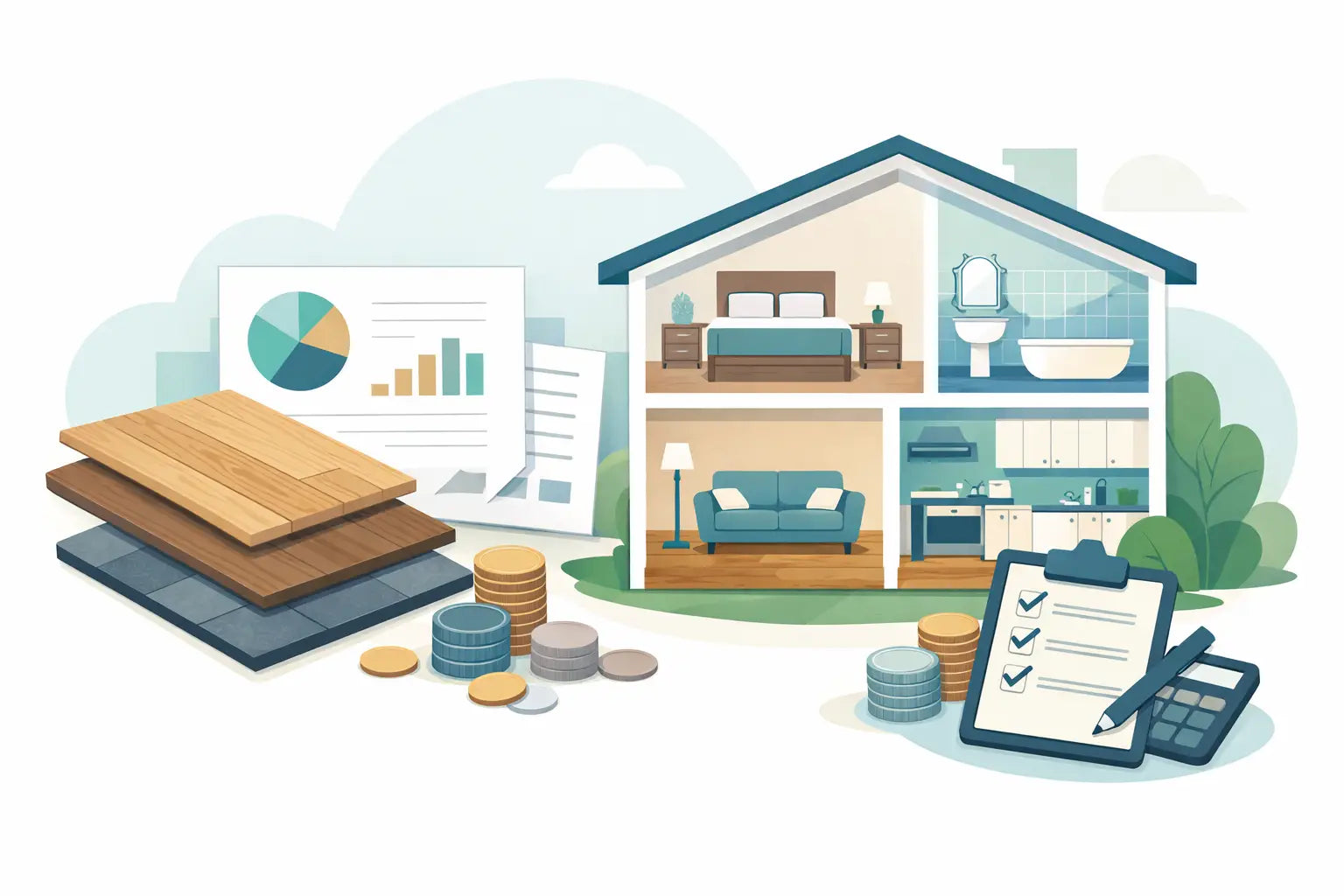
Sticker shock usually hits after the square-foot price looks reasonable. A floor listed at a great rate can still turn into a much bigger invoice once you add underlayment, trim, waste, delivery, and installation. That is exactly why a whole house flooring budget example is useful - it shows the real math, not just the headline price.
If you are budgeting for a full-home update, the smartest move is to build from total livable square footage, then adjust for room use, product type, and labor. A small difference in material price can change the project total by thousands, especially when you are covering 1,500 to 2,500 square feet. The good news is that buyers who shop first-quality hardwood, vinyl, and laminate at liquidation pricing can often step into better-looking, longer-lasting floors without paying showroom rates.
A realistic whole house flooring budget example
Let’s use a straightforward example: a 2,000-square-foot home with about 1,800 square feet of flooring coverage after accounting for closets, mechanical areas, and a little non-floor space. For budgeting, it is smart to add 7% to 10% for waste, cuts, and future repairs. That brings the working order quantity to roughly 1,930 to 1,980 square feet.
Now the real decision starts. If you choose one flooring type for most of the home, your budget is easier to control and the finished look feels more cohesive. If you mix products by room, you can sometimes save money, but transitions and labor complexity may offset part of that savings.
For a vinyl-heavy whole-home project, a practical material budget might land around $2.00 to $4.50 per square foot for first-quality liquidation inventory. On 1,950 square feet, that puts material cost around $3,900 to $8,775. Add installation at roughly $2.00 to $4.00 per square foot depending on subfloor condition and local labor rates, and you are at $3,900 to $7,800 for labor. With trim, underlayment if needed, transitions, and incidentals, the total project may land around $8,500 to $18,000.
For laminate, a similar home might budget $1.50 to $3.50 per square foot for materials, or about $2,925 to $6,825. Installation often runs in a similar range to vinyl, though site conditions matter. Total installed cost commonly falls between $7,500 and $15,500 for the full project.
For hardwood, the numbers move up, but so does the finish level and long-term appeal. Material pricing for first-quality hardwood at aggressive liquidation rates may range around $3.50 to $7.00 per square foot or more, depending on species, width, and construction. On 1,950 square feet, that is about $6,825 to $13,650 in material. Installation can range widely, especially if glue-down, nail-down, stair work, or subfloor prep is involved. A realistic full project total can easily land from $13,000 to $25,000 or higher.
Those ranges are not designed to scare you. They are designed to keep you from underbudgeting by 30% on day one.
What changes the budget fastest
The biggest cost swing is usually not color or style. It is category selection, followed by installation conditions. A premium rigid core vinyl floor at a liquidation price can outperform a cheaper but lower-grade product from a big-box shelf, and that matters when you are trying to balance budget with durability.
Subfloor prep is the line item many homeowners miss. If the slab is uneven, if old adhesive needs to come up, or if the wood subfloor squeaks and flexes, labor can increase fast. Floor removal is another variable. Installing over an existing surface may save money in some cases, but not always. Sometimes the right move is to start clean so the new floor performs the way it should.
Room shape matters too. Open layouts are more efficient to install than tight rooms with lots of cuts, angles, closets, and transitions. Stairs can add a significant bump to both labor and material. If your project includes stairs, that should be priced separately rather than assumed into the main square-foot number.
Room-by-room budgeting works better than guesswork
If you want a more accurate whole house flooring budget example, break the home into zones. Say your 2,000-square-foot home includes 500 square feet of living and dining space, 250 square feet of kitchen, 450 square feet of bedrooms, 250 square feet of hallways and entry, and 350 square feet of bonus rooms or office space.
You might choose waterproof vinyl in the kitchen, entry, and main living areas, then continue the same floor into bedrooms for a single-look layout. That often makes sense for families, pet owners, rental properties, and busy homes where moisture resistance and scratch performance matter. In that case, your budget stays more predictable because one product handles most of the floor plan.
Another approach is to put hardwood in main living areas and bedrooms, then use vinyl in kitchen and utility spaces. That can create a more premium feel, but it also adds transitions, category changes, and usually a higher average material cost. It is not wrong - it just needs to be intentional.
For investors and remodelers watching margins, laminate can still be a strong value play when chosen carefully. The key is not chasing the cheapest box. Better visuals, locking systems, and wear performance make a difference, especially across an entire house where inconsistency becomes obvious fast.
Where shoppers overspend and where smart savings happen
Overspending usually starts with buying too many premium upgrades at once. Wider planks, thicker wear layers, embossed textures, and specialty finishes all have value, but not every project needs all of them. If the goal is a clean, durable, attractive whole-home result, focus on the upgrades that affect performance first and aesthetics second.
Smart savings come from buying first-quality material at liquidation pricing instead of settling for low-grade budget flooring. That is the difference between paying less and getting less versus paying strategically and getting more. It is also why product guidance matters. A lower-priced floor that is right for your use case is a win. A cheap floor that fails early is not a bargain.
Another smart move is simplifying the floor plan. Fewer product changes usually mean fewer transitions, easier installation, and a more unified look. Ordering accurately also protects the budget. Order too little and you risk a delay or mismatched lot. Order too much and you tie money up in extra cartons you may not need.
This is where tools like a room visualizer can help reduce expensive second-guessing. Seeing how a floor color works in your space before you commit can keep you from choosing a trendy sample that feels too dark, too busy, or too cold across the entire home.
How to set your budget without boxing yourself in
Start with a target total, then split it into material, installation, and contingency. A good rule is to hold back 10% to 15% for the unknowns, especially if you have not pulled up the existing floors yet. If your target budget is $12,000, you might reserve $1,500 for prep and surprises, leaving the rest for product and planned labor.
Then decide what matters most. If you want the lowest installed cost with strong moisture performance, vinyl may be the best fit. If you want a balance of style and value, laminate deserves a serious look. If long-term resale appeal and natural material are the priority, hardwood may justify the higher spend.
What you should not do is compare products on square-foot price alone. A $1 difference per square foot across a whole house is meaningful, but so is lifespan, water resistance, installation method, and maintenance. The cheapest line item can become the most expensive mistake.
For many buyers, the sweet spot is premium-looking hard surface flooring bought below traditional retail pricing, with expert support to avoid missteps before the order ships. That is where a company like Factory Flooring Liquidators fits the market well - better materials, sharper pricing, and practical buying help without the showroom markup.
If you are planning a full-home flooring project, treat the budget as a decision tool, not just a number. The right floor should make the house work better, look better, and cost less than you expected if you buy smart.